Local Frontier AI: Operationalizing Advanced Models
March 20, 2026
ExpertClaw Team
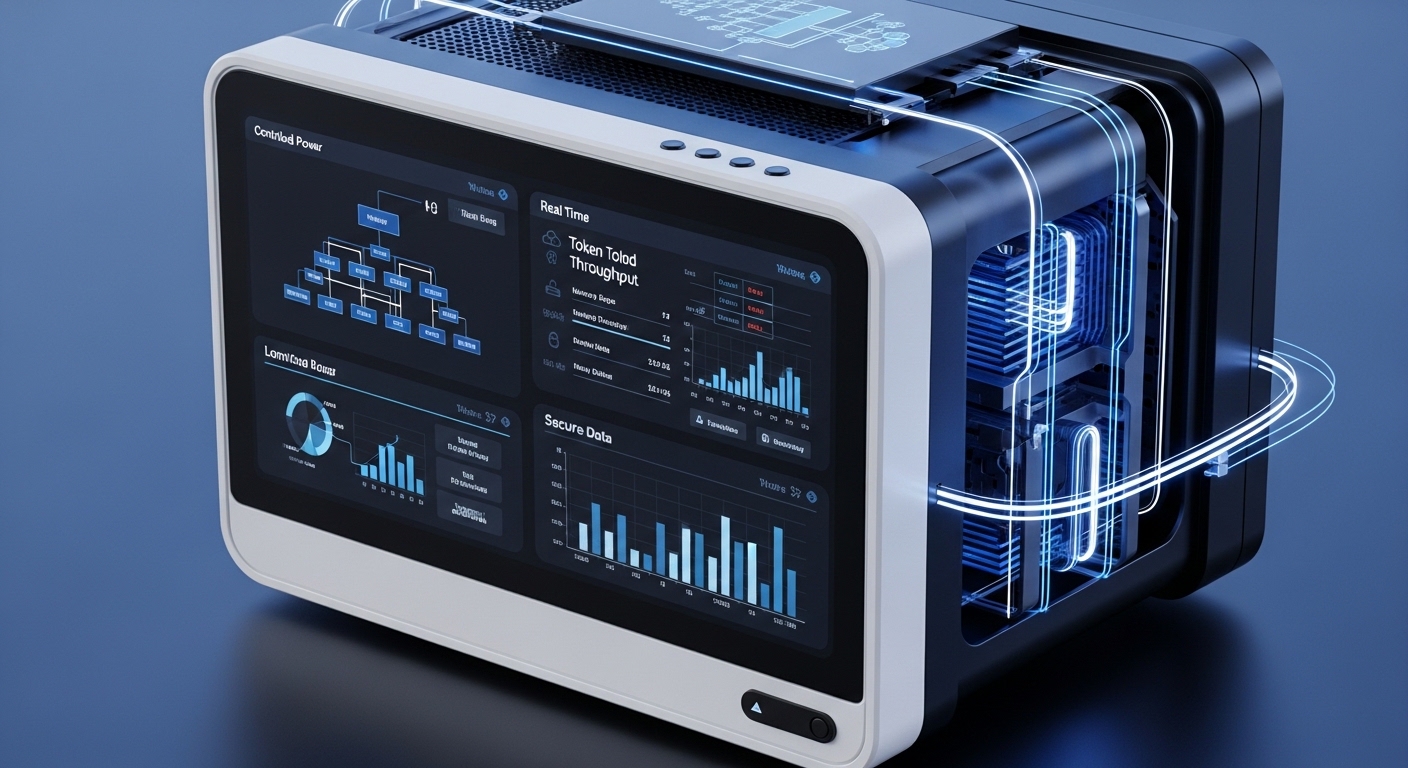
The promise of AI is compelling, but for operational leaders, the real value lies beyond the hype: it's in measurable improvements to specific workflows. While cloud-based LLMs dominate discussions, a key area is emerging: deploying truly advanced AI models directly on your hardware. This isn't about running smaller, compromised models. It's about bringing sophisticated capabilities to the edge.
Recently, an experiment successfully ran a 397-billion-parameter Mixture-of-Experts (MoE) model – Qwen 3.5 – locally on a MacBook Pro with just 48GB of RAM. This wasn't a distilled version; it was the full model, typically requiring 209GB of disk space. This feat, achieving 5.7 tokens/second sustained throughput, confirms a finding from Apple's 'LLM in a Flash' paper: fast local storage can effectively act as extended memory for large models. The business implications are substantial, but only with a clear view of implementation realities.
Why Edge AI for Business Operations?
Moving large language models out of the cloud and onto local hardware offers distinct operational advantages that directly impact security, cost, and control.
Data Sovereignty and Security
For businesses handling sensitive customer data, proprietary intellectual property, or classified information, cloud-based inference poses inherent risks. Local deployment ensures data never leaves your controlled environment. This is critical for:
- Legal & Compliance: Processing contracts, PII, or internal legal documents without external exposure.
- Financial Services: Analyzing proprietary market data or client portfolios securely.
- Healthcare: Handling patient records and research data under strict compliance regimes.
Predictable Costs, Reduced Latency
Cloud LLM inference costs scale with usage, often becoming unpredictable or prohibitive for high-volume tasks. Running models locally eliminates per-token fees and minimizes network latency, leading to:
- Cost Control: A one-time hardware investment replaces ongoing, variable API charges.
- Real-time Performance: Lower latency for applications requiring instant responses, such as real-time customer support routing or immediate data synthesis.
Tailored Integration and Customization
Local models integrate directly with existing internal systems, offering a deeper level of customization and control over the inference pipeline. This allows for:
- Optimized Workflows: Fine-tuning the model for highly specific internal data and processes.
- Custom Tooling: Building bespoke applications that leverage the model's intelligence without external API constraints.
The Technical Reality: Leveraging Modern Hardware
The ability to run massive models locally isn't magic. It comes down to architectural design. Modern silicon, like Apple's M-series chips, integrates CPU, GPU, and SSD controllers on a single die, creating a unified memory architecture with extremely fast internal data paths.
- Flash as Virtual RAM: SSDs in these systems offer sequential read speeds exceeding 17 GB/s, fast enough to stream model weights as needed, rather than loading the entire model into DRAM. This dramatically expands effective memory capacity.
- Sparse MoE Efficiency: Mixture-of-Experts models are particularly well-suited for this. Qwen 3.5 397B, for instance, only activates a small fraction of its experts per token (e.g., 4 out of 512). This means less than 2% of the total model weights are needed at any given moment, making streaming from disk highly efficient.
- Quantization: Further optimizing storage, weights can be aggressively quantized (e.g., to 2-bit) with negligible quality loss, reducing the on-disk footprint from 209GB to 120GB for Qwen 3.5 397B. This reduces the data volume needing to be streamed.
Operationalizing Advanced Local AI: Concrete Applications
This capability directly improves operations across various business functions.
- Sales Operations & CRM: Automatically synthesizing call notes into CRM updates, drafting personalized follow-up emails based on interaction history, or generating detailed opportunity summaries.
- Customer Support: Auto-triaging complex support tickets, drafting detailed responses to common queries, or summarizing long customer interaction threads for agents.
- Internal Research & Documentation: Rapidly synthesizing internal knowledge bases, generating executive summaries from lengthy reports, or populating recurring internal documentation with data-driven insights.
- Autonomous Agent Workflows: The experiment used AI agents for low-level engineering tasks. This same paradigm can be applied to business processes: an agent tasked with monitoring market trends, generating competitive analysis reports, or proactively identifying supply chain risks, iterating autonomously on complex data streams.
Execution Risks and Implementation Realities
Deploying advanced AI locally is not an 'install and go' solution. It requires a pragmatic approach to systems, integration, and ongoing governance.
Hardware and Integration Complexity
- Beyond the Box: While modern hardware provides the foundation, integrating these models involves more than just an API call. It requires custom inference engines, low-level I/O optimization, and deep understanding of specific hardware architectures (e.g., Metal Shading Language, MLX framework).
- Resource Allocation: Identify which operational workflows justify dedicated hardware resources. Not every task needs a frontier model, but for those that do, ensure adequate compute power and storage are provisioned.
Performance Optimization and Tradeoffs
- Performance Tuning: Optimal performance often means counter-intuitive decisions. For instance, the experiment found that deleting a carefully engineered application-level cache and trusting the OS memory management made the system 38% faster. This shows the need for deep system-level understanding.
- Balancing Act: Deciding on quantization levels or expert pruning (e.g., reducing active experts from 10 to 4 in MoE models) involves tradeoffs between model quality, speed, and resource utilization. These decisions must align with business requirements for accuracy and throughput.
Governance, Monitoring, and Rollout Strategy
- Guardrails: Local deployment doesn't remove the need for robust governance. How will you monitor model outputs for drift or hallucination? What are the human-in-the-loop mechanisms for critical decisions?
- Iterative Rollout: Start with well-defined, contained workflows. Measure ROI rigorously. Iterate and expand based on clear performance metrics and user feedback. Avoid big-bang deployments that can introduce unmanageable risk.
- Skill Gap: In-house teams may lack the specialized expertise for low-level AI system design, integration, and optimization. Partnering with specialists is often essential to navigate these complexities and mitigate rollout risk.
The ExpertClaw Difference
At ExpertClaw, we know AI's true potential comes from precise, measurable execution. We don't chase hype; we engineer solutions that deliver tangible ROI by reducing operational drag and tightening execution.
Running frontier-class AI models on your own hardware is no longer a theoretical exercise. It's a proven capability that offers significant control, security, and performance for critical business workflows. However, transitioning from proof-of-concept to production-grade automation needs deep technical skill, a business-first perspective, and a focus on the delivery realities of complex systems. We help teams navigate these complexities, ensuring that advanced AI delivers on its promise for your operations.
Ready to Elevate Your Infrastructure?
ExpertClaw transforms the promise of OpenClaw architecture into production-grade reality. Secure, scalable, and operationally robust AI infrastructure tailored for enterprise needs.